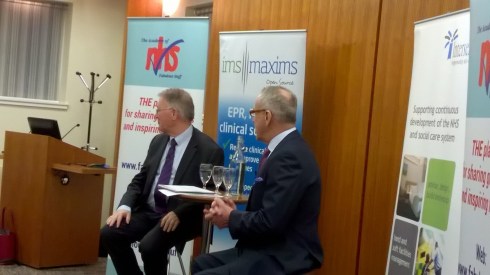
Duncan Selbie – Public Health England

Another evening at The Kings Fund in central London.  These Heath Chats where Roy Lilley (of nhsmanagers.net fame) ekes out more than Paxman ever did, by being both disarming and opinionated and sometimes rude for the sake of it…are always a good thing to attend, or catch live on Periscope, or even watch the whole again on Fab Nhs Stuff Web site You Tube channel.  As ever – these are my views of the session, so are bound to be different from your own.

Duncan Selbie

Duncan Selbi-


I have to start with the other great reason to go. Networking.  You can chat with like and not like-minded folk, whose common denominator is wanting to keep health care in the UK at the top of the world tree.  If only the politicians would get out-of-the-way and let those who know and love it to just do it.  But I had a worrying chat with a GP leader from the East Midlands area.  They told me how the service was near breaking point. 6 surgeries had closed their doors in the last year.  That of course puts more strain on the remaining practices, and probably A&E and secondary care and all the social services too.  They told me that it wasn’t early retiring GPs that was creating the problem – which is what I had assumed.  The problem was many younger doctors leaving the profession completely. Most were under 45.  Female GP burnout was even younger – before 40.  And it does take 10 years to grow a GP – and not enough are entering training too.
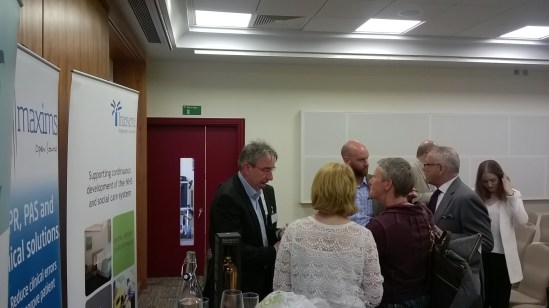
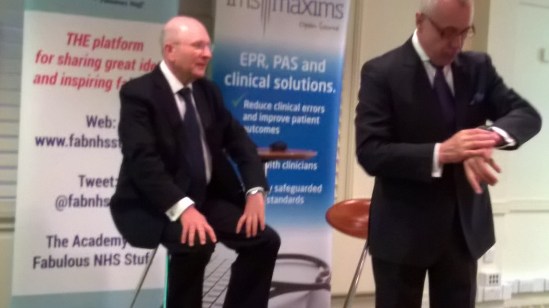
WP_20160621_19_47_35_Pro

Duncan, Roy and The Sheffield Massive


I didn’t ask why.  I could guess being unloved and unsupported by your ultimate boss, Jeremy Hunt, being berated by the press, being accused of greed and of being overpaid, having over inspection by a non-understanding CQC, having to buy services via the CCG system, and trying to run a viable business and wanting to give excellence in service with squeezed resource (both money and people), and being choked by regulation and form-filling cannot make for a fulfilling work experience.

If this is being repeated country-wide, then nothing that Duncan Selbie and his team will do will have any effect.  I suppose the Tory Party knows that the voting public will never forgive a government that damages the NHS beyond repair.  And will not vote for them.  I can but hope.  You can’t be short termist and always making the Austerity choice when it takes 10 years to grow a GP.  It is not a tap we can just switch on. Here’s an off the wall suggestion. Be nice. They may not leave then.  That’s my only short-term suggestion.  And get the inspectors to hell out of there.

I liked Duncan.  Not being racist here, but it does sound interesting when a Scottish accent tells you he is Chief Exec of Public Health England…it may just be me!  He’s been a legal immigrant to The Southern Country for quite a while now…

As ever, we get more about the man with Roy Lilley’s avuncular, been there and done it, approach.  (And Happy Birthday to Roy – 70 today. Only a bit older than the NHS…).

Both Duncan and Roy had risen through the NHS ranks without the burden of a Degree.  Left school as early as they could (and I don’t mean 3:25 pm).  This sort of rise might still happen in the NHS – it seems Apprenticeships are making a comeback.  Being able to rise through the echelons of a public service seems a great way of self-improvement and making leaps across class and glass ceiling and old school tie divides.  If you are good enough, and committed enough, you should be able to break through, not just because you went to Oxbridge?

Duncan Selbie started in the NHS in 1980.  He was 17.  As a Clerk. At 19, moved to London (to keep having a job), as a Cashier at The Queens in Croydon.  Starting low, and building, as you can see.  One of the huge strengths of the NHS as an organisation.  And myriads of the audience were nodding along – because they were the same. (We have got to fight for this to be perpetuated). Hospital Administrator was the next role. with Bollingbroke saying “the old don’t need to be in hospital”.  We still need to work on this. (I am convinced that the Buurtzorg model of home care must have some utility in our system?). A move into Mental Health sounded like it was one of his favourite jobs – (Mental Health Trust in South west London out of St Georges.) He is very people centred – 3 homicides in 12 months, one a member of staff, killed.  He knew when he was on TV being interviewed that what he was saying was for his staff, not the geenral listener, who had to come in that day and do the same job knowing what happened…a great dollop of emotional intelligence.  Nigel Crisp quote from his time here?  “No-one will bring everything to a job.  What you bring will be unique.  And so will everyone else”.

When he moved on to being Performance Director of the NHS, he didn’t realise he was crossing the line to becoming a Civil Servant. Off to Brighton. Which he loved.  Being in control of nothing and totally in charge!  It was 15 minutes from disaster when he arrived.  By the time he left, Duncan said he had improved that to 30 minutes.  I bet it was nearer to an hour…His PA, Ros visited him. After observing for a day she said. “You’re having a laugh.  It’s like you are on your hols.  You only do  three things.  You wave at people.  You say ‘good morning’.  And you send thank-you notes”.  “And what’s your point?”, he said.  Listen and learn, dear reader.

Public Health England?  As Roy said – covering everything from Porton Down to Pork Sausages.  He couldn’t tell us much about Porton Down – or he’d have to wipe us all out…so we didn’t ask any more questions.  I think my conclusion was I am glad thay are so professional and on our side. At one end we have Protection of Public Health.  At the sausage end, Improvement of Public Health.  I loved their Sugar App – it reads bar codes and tells you how many sugar lumps are in the product.  2 Million users – and kids love it. The app had caused angst – amongst food producers.  So they must be heading in the right direction.  We are talking evidence led campaigns here, from Sugar levy, to other aspects of childhood obesity, to plain packaging on fags, to air quality, to smoking itelf.  And social aspects of mental health – people have to have someone to care for, somewhere to live and to have a job.  The remit sounds almost too wide to me.  Luckily, he seems to have a fantastic and well loved and respected team. (Can you go and mentor some people in the Department, please Duncan?).

Naturally, there are occasions when the advice is considered by the great and good as being rather Nanny State.  “Who are you to tell me when I should die” someone asked.  “Not everyone has your choices, Professor”, was the sensibly controlled response.

He is driven by attempting to reduce the gap betwen longevity of the affluent and those living in degradation.  The same for survival rates with various cancers.  Laudable, and grand.  But it might all start with getting Home Economics back onto the school curriculum.  Central and to the fore.

It’s the first time I have been to one of the Health Chats and left thinking, not only do I think this man will really carry on making a difference, but also, I’d love to work with him and help.

A smiley journey home…

Lord Carter Health Chat – reflections

OK. I’ve been on holiday, and just catching up on Roy Lilley’s friendly chat with Lord Carter.  (You can watch the whole thing on the NHS Managers.net You Tube channel by clicking here )

Patrick Robert Carter, Baron Carter of Coles, otherwise flagged as “Lord carter of Bog Rolls” by Roy Lilley.  I think Roy may have swallowed too many pieces in Private Eye for his own good…but I do understand good procurement can save a lot of wasted cash, so why not simplify it to the bog-rolls metaphor?

It is bigger than that, of course.  The interim report and the final report (here) is about operational efficiency varaitions across English acute hospitals.  I’ve heard Roy say many many times that all we have to do is show people what good looks like, and they will do it and maybe do it better.  It was quite strange to not see Roy’s lips move (and any who know him realise this probably only happens when he is asleep…), but I heard almost exactly the same words falling from Patrick’s lips.

Here’s my favourite sentence from the Executive summary of The Carter report (as it will always be called.  “Operational productivity and performance in English NHS Acute hospital: Unwarranted variations.” – is more of a mouthful, but does provide a neat summary of it’s own, as a report title should!)

“We conclude that there is significant unwarranted variation across all of the main resource areas, and although we found many examples of good practice, no one hospital is good at everything. resource areas, and although we found many examples of good practice, no one hospital is good at everything.”

One of my constants beefs about the contagion that is report writing is that is what many will remain.  A report.  Not an action plan.  Not helpful.  Not going to change anything.  Why could and should this be any different?  There’s the same pressures in other health care systems.  As Lord Carter said in the report, the NHS ranks as the best value health care system in the world.  Guys – he is on the same side as you!

His work life seemed to revolve about being the go-to person when something is very broken. Wembley stadium anyone?  I suppose we should have noted the project may be late when the Australian workforce started betting on the due dates being missed!  But he got in there and helped sort it.  He was also on the bid team for the 2012 Olympics – and I’m guessing the IOC would welcome some help with Rio now.

Already some of his attitudinal philosophy was spilling out. “There are a lot of good policy decisions (plans to the writers mind) being made.  Execution is often boring and bad.  Attention to detail and keeping at it are key”.  “Keep the confidence of the politicians, and get the money right”.

I loved the simplification thinking.  “What does a good rota look like?”  This really isn’t leading edge and scary – it’s day to day and practical.  “Most people respond to data”.  Don’t you love that?  Other questions on what is the appropriate level of care, which varies by ward, by hour, by specialisation.  Not a blanket “6 patients per nurse”  or whatever.

Some randomly disjointed thoughts – but all allied to simple management:

  • Everything is about management
  • It’s how you run a business
  • We need to deal with local conditions
  • Just need hospitals to spend the money right
  • Acute hospital is the dominant partner in the system (and don’t forget that, please, I say!)
  • We need basic information that people we are talking with will respect
  • We need to pool and share data
  • NHSI (i.e. Not Monitor) need to be sitting down with Trusts and help them to switch to better buying

The NHS is a noble cause.  I just get the feeling that Lord Carter’s approach has identified the right bottoms to be kicked, as well as giving a super charge to the sharing and using of great methodologies and ideas.

Let’s just get the data, share what good looks like, and let them – the front line – get on with it.  Can it happen?  Yes.

One last statistic of the night.  The live feed trended on Twitter.  Roy has never managed that himself, so I suspect was deeply jealous!

(And one other place for sharing great ideas? – Lilley, Jon and the Blonde have a very fast growing forum: The Academy of Fab NHS Stuff. Go see)

NHS Health Chat: Niall Dickson

Roy Lilley does get some of the great and the good to sit in the interviewing hot seat.  And go live on Periscope (available for 24 hours after the event.  And a recording is also made for FabNHS Stuff You Tube channel.  So even if you weren’t there last night, you can watch if you wish, by clicking HERE).  My views here are for those who still like to read instead!  They are my views, and mine alone, so feel free to disagree with my opinionated take on these events.

WP_20160503_17_41_21_Pro

“Is that the time already?”


The fun began before we began. “I’m not Chairman, they’ve spelt my name wrong, and I am early…and how are you Roy?”.  So what is Niall’s position (pronounced ‘kneel’, in case you didn’t know). OK – he is Chief Executive and Registrar at the GMC.  Since 2010.  Until the end of 2016.  And wouldn’t divulge what his plans are after that. “No plans really Roy.  A few ideas, But nothing firm”.  Yes Roy, it’s a chat here, not a job interview!

These chats are so useful to get the back story.  Virtually every one of the people I have seen and heard have a very varied back-story.  Those who haven’t do tend to be rather more stuck in their thinking, I feel?  Many years ago, I remember Charles Handy (Management Guru) saying most people would have three careers – that is, completely different job avenues – if they stared work in 1990.  The 40 year one company career is over.  Just consider Niall’s c.v.

  • Teacher – wanted a profession to fall back on…
  • if real love, Journalism failed.  It didn’t. He always wanted to write. Ended as editor of The Nursing Times – 90 000 copies sold a week…
  • 2 days into Publishing Editor job – offered to become Medical Correspondent at BBC.  Couldn’t refuse…
  • Kings Fund, as Chief Exec (2004 to 2009), before the move to GMC

I felt like the journey had given him so many tools in his leadership bag. One interesting opinion from the mad pace of news correspondent life was the challenge of just being ‘on’ with very little reflection time.  I think the same happens in most change situations.  If we think about the level of tinkering or outright reformed changes of direction in our Health care system – how much reflection time is built in?  We are constrtained by short-termism.  And lack of money.  Or badly planned spending.  All beciase of lack of reflective thinking.  We all need to step back, whether giving a piece to camera on the 10 o’clock news.  Or planning how to turn a hospital deficit around….

Quotes:

“If you just pour more oil in, and you haven’t fixed the engine, then you will spill some”  (This doesn’t sound like a criticism of increasing spending from 7% GDP in 2007 to 11.3% – the European Average – in 2009 under Blair – but you can see the power of the analogy?)

“The enemy of all the great ideas for change is time” (I may steal that one!)

“Changing culture is really difficult” (Amen to that).

“The English only have one religion and it’s the NHS” (Quoted Nigel Lawson, now most famous for being Nigella’s dad, rather than ex chancellor, climate change denier and less).

WP_20160503_17_41_08_Pro

All smiles at the end…


It did get a bit feisty.  I think Roy was attempting to get an unguarded moment.  So, questions about think tanks not thinking, the letter from GMC to Junior Doctors about not striking, (but, naturally, that wasn’t quite what I said), and where do we draw the line between social and health care.  And what about the Social Care Sector itself – becoming a basket case of inability to make profit?

The cumbersome legal process and the time taken to investigate Fitness to Practice, was acknowledged by Niall as a problem.  As was the use of weekend data at the centre of the JD dispute (in theory.  I don’t feel we gained any new ideas from Niall – just mainly acknowledgement and maybe something should be done.  I felt more politician, ambassadorial answers than open forthrightness.  Maybe that absolutely goes with the territory and the role?  Maybe that’s what he misses, and will look for in the next role?

So, should we abolish Professional Regulation?  Now, another quotable answer: “The last person to do that was General Pinochet in Chile…”.  Yes, experience and depth do matter in senior leaders.  The GMC is supportive of high standards and good practitioners, I feel.  Having a confidential help line, whilst morale is so low, is a useful innovation.  2000 docs have used it already.  The GMC is almost bound to be hidebound, and slow and sure?  But at least they do have the core value of improving practice.  If it takes time, it takes time.


Roy Lilley chats to Jim Mackey

I watched this NHS Chat on Periscope. If you want to witness the whole super open frankness from Jim Mackey, you can catch it on NHS Managers You Tube channel by clicking on the coloured link…

s216_Jim-Mackey-chief-executive-[1]

Jim Mackey

Jim Mackey – Chief Executive at NHS Improvement.  Geordie.  Newcastle supporter (and thinks they will be relegated). Commutes. Gets peace and quiet on the train.  And was just so unbelievably straight. As ever, these are my views – and one step removed as I couldn’t physically be there.  But hey, that’s what technology is for.

Best bit?  Roy kept trying to get Jim to talk about the Junior Doctors strike.  His final answer.  “You’re very persistent aren’t you?”  Just not answering at all.  Wry giggles all around…but we really got some other strident and out there quotes.  It felt good.

Yes, he has been there and done it.  Accountant, and been chief executive of a Foundation Trust.  Now, from April 1st, NHS Improvement “brings together Monitor, NHS Development Authority, Patient Safety, the National Reporting and Learning System, the Advancing Change Team and The Intensive Support Teams”. This makes the job of Chief Exec sound onerous in the extreme. But if Jim’s answers in this chat are anything to go by, then he will cut through the crap.  His core drivers and beliefs make me feel he will make a big difference and fast.  Simplify seems to be the core message.  Here’s some tasters:

“You need firstly to create the circumstances for people to have a good chance (of succeeding).  Then have a clearer framework – people like rules. Then get behaviours right”

“Regulators?  Get it right for one, then you fall foul of another.  I just ignored them”  (I cheered when he said that).

“Need to think more as a team. We decided to ignore the 1 to8 (nursing to patient ratio) and worked with our staff on each ward to come up with the plan.  Great nursing Director made it happen”

“We need to all be working with one set of figures.”

“If the A&E crisis – 20% more this February to last – and the problem is caused because people cannot access Primary Care, then you need to fix that. You can’t pretend it’s not happening.”

(My idea for this?  Set up a GP surgery, manned by JDs – who are there 24/7, as we all know.  And let the patients come.  And cross charge each visit back to the GP surgery they are registered with.  I would think Out of Hours services would improve rather swiftly. As would not having to wait a week for an appointment…)

“You can’t fix anything if you don’t talk to each other”

“The NHS is the best in the world – especially viewed £ for £”.

He is a practical man.  Jim Mackey will make change happen.  His ideas for fixing the most complex problems is as obvious as it is difficult.  Break it down.  Measure the right things.  Talk.  And get the front line to design the absolute best ways to ensure excellent patient care.  That’s what we are there for.  That’s what Jim will make happen, as the Geordie Catalyst.

(And I think Newcastle will stay up!)

Leading Innovation, Creativity & Change

I went to a book launch at The Virgin Money lounge last week, near Piccadilly. I’ve known Peter for some time, but this is the first actual launch of a new title I had got to.  This may be his 10th or 11th  book – mostly all his own work, but one or two collaborations.

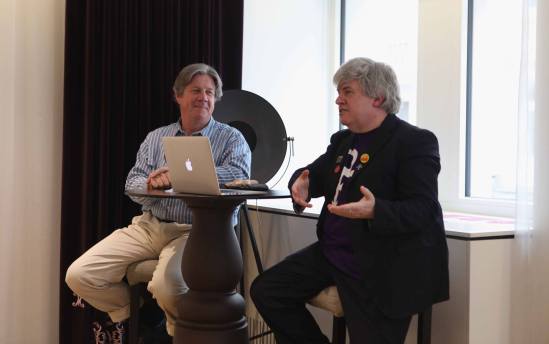
Peter Cook & Prof Adrian

Peter Cook, grilled mercifully by Professor Adrian Furnham


What did I learn?  Well, having someone of Adrian Furnham’s standing (Professor of Psychology and University College London)  does help to boost the level of intellectual swashbuckling that peppered the proceedings.  And it did mean the audience could direct their questions to the author or Adrian…but most were polite!

Another business book?  Not really.  Leading Innovation, Creativity and Enterprise   (click to see more), really is a synthesis of theory and practice – as is Peter’s wont and style.  It is about the art of creating great ideas and converting them into profitable innovations in business.

This was one of the core ideas, for me – my own ‘light bulb’ moment.  “There are loads of ideas – too many to count, but the real success key is to do the innovation piece.  Actually making the idea work and making profit from it”,  said Peter.  Creativity is not enough then.  We have to put it into practice too.

Because Peter is also a musician (and many of his books reflect that predilection – e.g. “Sex, Leadership and Rock ‘n’ Roll!” ), we did have a discussion centred on different types of creativity.  Adrian mused on artistic versus scientific.  “Creatives are difficult sometimes”.  He was referring to the Artistic types. They need to be ‘in the flow’ (in the zone?) – to be creative. The scientist types appear more focussed, and not needed the muse so much.  We got more quotes (as you might expect from a book launch?)

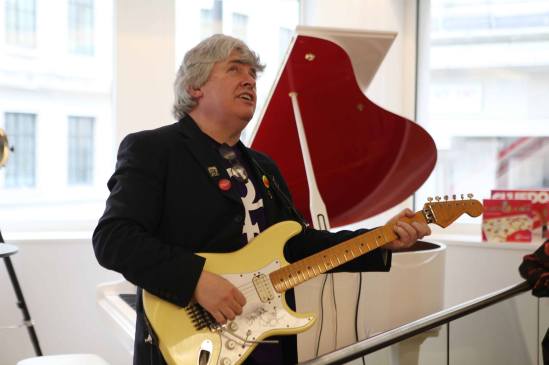
Peter Cook spotting the muse decending!

Peter spotting the muse descending?


“How many Psychologists to change a light bulb? Only one – but the light bulb must want to change..” (that was Adrian again)

“If facts don’t fit the theory, change the facts” – Einstein – no, he wasn’t there, just quoted by Peter.

“Bedroom, bath and bar – good places to foster innovative ideas” – yes, for Peter, but others may need different situations and environments to help them?

“We need to move from BBI to BBE – from Brawn Based Industries to Brain Based Enterprises”  (I assume Peter needed the Bar, Bath and Bedroom to think up two new acronyms!)

Did you know there are 70 000 books with ‘Leadership’ in their title in the British Library?  And that of the Big 5 Psychological States, the two that predict everything are Conscientiousness and Neuroticism?  And that 55% of creatives are born not made?

Well, you would have done if you had attended this book launch!

Alternatively, you can get most of this, and have yourself a practical and highly useable manual if you peruse yourself a copy by clicking here – Leading Innovation, Creativity and Enterprise

(And if you ever need a rather special photographer, these were taken by Christina Jansen – click to see more of her work)


Ronnie Corbett

P1080363

Perhaps nothing more needs to be said?  But if we in everyday organisations could take lessons from Ronnie about humour, timing, customer service, professionalism, friendship, and love of life, then everywhere would be a nicer place to work.

Care Quality Commision

The CQC.  It was one of those nights at the Kings Fund, at a quiet little Soiree with the Head of Hospital Inspection of the CQC, Professor Sir Mike Richards just having a quiet little Health Chat with Roy Lilley (NHS Managers.net – just in case you haven’t read the e- newsletter – “it’s more than a blog”!) (And you can see the whole thing, here)

Professor Sir Mike Richards and Roy Lilley - avoiding me!

Prof Sir Mike Richards & Roy Lilley avoiding me!


Roy Lilley has not been backwards in coming forwards with his criticism of the whole concept of inspection actually being of any use whatsoever. ( So, there were many present – at a sold out meeting – who may have been there for the blood sport?)

As ever with these missives – this is my view of the evening, and my opinions.  I spoke to a few people afterwards, and questioners at the meeting, who all seemed to think it was a score draw.  Both protagonists remained intact, neither hit a killer blow, and most of the audience could feel positives on both sides of the argument.  I still lean more to inspection being too rear view mirror, too mired in ‘you have to find something’, and more remembered for the negative than the positive.  I shall attempt to remain as neutral as I can, but don’t hold your breath!

We get the Deming quote (“Fourteen Points of Management”) up front from Roy (but that was after his introductory “As you know, I can’t stand the CQC”.)  “Deming’s 3rd point was “cease dependence on inspection to achieve quality”.  Sir Mike smiled a little.  But we did get some insight into his back story first.  It did feel a little like we were waiting for hostilities to begin though.  Occasional sharp intakes of breath, but it was just a chat before it got serious.  Sir Mike Richards had been Oncology Czar (National Cancer Director)- and he felt this and his board level involvement at Guys and St Thomas’s(?) had equipped him well for his current role.  To be fair, the strides taken in diagnostics and screening – and borrowing best practice from other health economies all sounded like very powerful statements of effectiveness in the cancer field.  “But why should you be chief inspector of hospitals when you have never run one?”.  This was Roy attacking The Elephant in The Room.  Sharper intakes of breath…but good answer “I don’t do it on my own”.

The CQC is Peer review with teeth, is the argument.  There was discussion on cost “It only costs 0.1% of the turnover of a hospital to have the inspection”.  And I agreed with the assertion that running a hospital well is cheaper than running a hospital badly. Hospitals inspected that had a poor quality of care were more likely to be in deficit.  There were great stories of hospitals that had been in  a parlous state, with some assessed at the inadequate level, and others needing special measures, who had managed to turn things around.

OK – this is where I began to hyperventilate.  I get the positives; External and Independent review could be the best cheap consultancy you ever had; There will be blind spots and mistakes in every hospital, and an inspection could at the very least put the spotlight on that; and having a review will stiffen the resolve to get things better.

I can feel negatives though.  Even the term ‘Special Measures’ felt wrong.  Prof Richards glibly commented this had been borrowed from Education.  Lazy, I say.  It’s such a pejorative and negative phrase.  And how does a Board and CEO hope to attract the best staff if their hospital is under special measures?  Would you?  Many of the successful and “Beacon” Hospitals have had long term Chief Execs.  The turnover of Chief Execs in other less favoured hospitals is becoming a tsunami. 365 days was quoted as the tenure average now.  Would you do it?  Last October I wrote a piece about a previous Health Chat with Keith McNeill, ex CEO at Addenbrokes in Cambridge.  Roy brought the fact that McNeill had left after a poor result following a CQC inspection.  75% of the Consultants at the hosptal signed a letter asking him to stay.  And herein lies the base line problem I think.  An inspection will point out the positives and the negatives.  Human nature being what it is, 99% positives will not be seen by you as a member of staff, or indeed by your local colleagues or the Press. You only see and feel the horror of that 1%.  There may have been more problems than I have seen in press reports and from the October chat.  I haven’t read the full report.  But hounding someone out who had been headhunted from Australia, who had a different attitude – (Keith concentrated on outcomes, not inputs) – just feels wrong to me.  Maybe he had ruffled feathers?  I still don’t buy it that Board members are thankful for the CQC pointing out their bad practice.  That is maybe what they say to the inspectors face…

There was one positive action that fell out of a question via Periscope from Roger Kline. The CQC could be the engine to spread good practice.  The Academy of Fab NHS Stuff offered to be the conduit at this meeting.  I hope it happens.

But I’d like to suggest something more.  The NHS is our biggest employer.  1.4 million people. It is a people led organisation.  As Roy says (often!) show people what good is and they will get on and do it better.  We need strong, visionary involved managers and leaders.  Why not have a Sandhurst equivalent?  Why not use the methods and ideologies of Investors in People to drive up the communication, leadership and people skills in each and every hospital?  This method looks at input and outcomes measures.  Just because outcomes are harder to measure shouldn’t mean we don’t do it!

Managment according to Jurgen Klopp

OK – this is a football themed blog.  I do try and have my ideas from many sources, and those of you who follow me on Twitter, reading the 08:15 quotes entitled What I Learnt yesterday (#WILY) will know I pull ideas in from many and varied sources.  I think stories and metaphors are very transferrable – and Mr Klopp, Liverpool FC’s new and charismatic manager, is a veritable source of inspiration for me.  Also, as a Liverpool fan, I am excited at what he might help the club achieve.


He does feel more manager, day to day, than leader.  Maybe we just don’t see the long term visioning, the thinking the unthinkable, the 5 year aims and plans.  We see the instant, live reactions of a passionate and thoughtful man.

I think his most impressive traits are very worthwhile trying to emulate.  Here’s my take on his style:

  1. Disarmingly honest.  Personified in Press Conferences.  The sports reporters feel notoriously extreme in their views, and rather biased.  Liverpool beat Chelsea at Stamford Bridge early in his time as the new manager.  “Are you going to win the league then?” His reply? “Are you crazy? I hope I didn’t understand the question. I have been here 3 weeks. You think after 1 win against Chelsea we can win the league?”.  Lesson?  Beware of optimistic expectations that are unrealistic.  It is best to nip these in the bud straight away.
  2. Simple, clear thinking.  (See the photo and caption above).  That is not rocket science, at all.  But it transfers so well to any organisational situation.  If you are being successful, it is far easier to have a lot of lee-way and support for your most outlandish ideas.  If you are in turnaround, no one will release the budgets to you.  Sadly, that’s when you need more support.  Moral – ask big when you are riding the success wave!
  3. He works on the team performance through motivating and supporting individuals.  He knows when someone has done something above and beyond.  He makes a bee-line for that individual at the end of a match, or even at half time.  And shows his delight by chatting, slapping on the back and cuddling them!  And guess what?  They perform better next time they play.  And the other players?  they try harder so the boss notices.  Is this transferrable to your situation?  If you say no, then leave the room this instant!
  4. He is not averse to telling people off.  One of the Liverpool players – a star of two seasons ago – Daniel Sturridge, has been injured for most of the season.  “He must learn what a real injury is, and play though the pain sometimes”.  Yes, this really got up the superstars nose.  But guess what?  He is back now, and wants to prove his worth to the manager.  The rumour is, he also told the player he would be quite happy if he left the club.  That could go either way, but it worked.  Moral?  Don’t let poor performance become tolerated.  Your whole team will go backwards otherwise, and everyone will stop pulling their weight.

There is plenty more, and plenty to come, I feel. I have found some of his quotes very thought provoking and a bit different.  They have certainly helped me come up with some memorable What I Learnt Yesterday tips! Search for me on Twitter @canmencook, then look for the #WILY.  Every day is a school day – if you look around you and open your eyes and ears to taking lessons on board.

Enjoy!

NHS Health Chat – On The Road

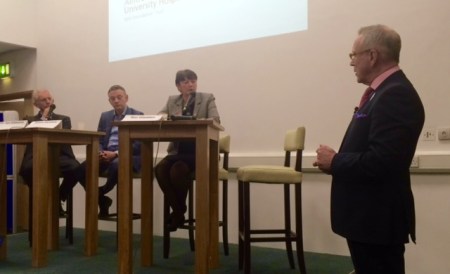
We were on the Road – Aintree University Hospital, in Liverpool. 170 people in the auditorium.  Wow.

The panel?  Sir Ian Gilmore (Renal Czar; Advocate of minimum unit pricing for alcohol; holistic thinker) (sorry, health warning – my views of the event, as ever, not checked with organisers or speakers – sorry!).  Simon Bowers.  GP and Clinical Vice Chair of Liverpool CCG.(Clinical Commissioning Group).  Famous for a Panorama programme – “A day in the life of a Clinical Commissioner”.  Patient advocate.  Roz Gladden.  Local councillor.  Soon to be Lord Mayor of Liverpool.  Housing Officer originally.  And a bit into the joined up thinking that will be needed with Devo Liverpool coming along (probably).  Making sure the holistic approach will actually happen.

We were there the day after the Junior Doctors second strike.  Made some of Roy Lilley’s lines of questioning and provocations easy. They all felt that Trusts – who will after all pick up the pieces that any of the negotiators agree upon, are really caught in the crossfire. We are in danger of risking care to the patients by taking our eye off the ball, they argued. What people want at the front line is the freedom to drive up quality and safety. Through the day we had attended exhibitions of The Academy of Fabulous NHS Stuff ideas, under the auspices of Healthy Liverpool.  As Sir Ian said, Liverpool has made substantial progress – from a very low base.  But the number and quality of simple actionable programmes being showcased here is what is driving the successes, I think.

Roy ad Panel Liverpool

Roy Lilley and Panel


Some other quotes and highlights?  As ever, Mr Lilley was provocation personified.  “This is barmy – you haven’t put Healthcare into Devo Liverpool” (it will be in the next phase…). “The CCG’s can’t agree – so places like Aintree Hospital don’t know which pathways to use for discharging – because it depends where the patient lives”  (This does sound daft to me.  The locals call it “What colour is your wheelie bin?” Each authority has different coloured bins dependant on geography.  Roy lost some of the localism.  “The 3 CCGs go from out near the Woolly Backs in the south to posh Southport”  Woolly backs are the non city dwellers – who can see sheep from their gardens….).

Is it time to amalgamate the CCGs to be co-terminus with Local Authority boundaries served by the local hospitals?  Fewer meetings, less administration, and simplification?

There was a lot of discussion about the interface between medical and social care.  The Buurtzorg model of nursing (and cleaning, shopping, cooking, bathing and more) from Holland was mentioned again (Google it).  We do seem in a ‘full bed occupation’ stranglehold because of the interface between health and social care becoming a barrier rather than an enabler. The panel all agreed though that multi disciplinary teams residing in the Primary Care surgery improved communication and effectiveness.  And, an absolute truism, borne out of bad experiences, was never to cut Public Health budgets when money is tight.  It is a false economy.

Sir Ian remained optimistic.  Yes, we could see a time of working better together.  There is a lot of passion to make things continue to improve.  Perhaps the horrors of squeezed budgets and austerity at least foster innovation?  There does feel like there is both a vision for a healthier Liverpool, and opportunity to turn talk into action.

Saddest moment?  One of the contributors would not want their kids to follow them into medicine.  If you keep kicking people (from our Press to the Government) eventually people will give up.

I didn’t feel that after this meeting.  The place crackles with energy and positivity.  And much of the force of nature up in the north west is very copy-able.

I suggest you all check it out via the Fab NHS Stuff portal – and steal with pride from the Scousers!

Lilley and The Blonde

This sounds like the start of one of those News of The World (remember that) stories that ends with “So we made our excuses and left….”

We were not at a house of ill repute.  We were in my home city, Liverpool, and Fab NHS Stuff- run by Rot Lilley (of NHSmanagers.net fame), Terri Porrett and Jon Wilks.  The repository of good ideas – www.fabnhsstuff.net – was on the road!

Roy & The Blonde

Roy and The Blonde


The exhibition – sharing centre of posters and people – was so invigorating.  And you know, Terri was right in her overview at the lunchtime talk.  Most people (she singled out nurses) put down their achievements – you know the “well, it’s only a little thing’,  and “it’s just my job” – and “I’m sure everyone is doing this already”. sort of comments.  And Lilley and The Blonde were here to tell everyone that they were wrong to down play the fab stuff.

The web site has had over half a million page reads in just less than 1 year (14th Feb 2015 – sort of links to Love your NHS on Valentines day?).  They get 1500 visitors a day.  Perhaps even the CEO of the NHS, Simon Stevens (Sir), and Jeremy Hunt, current Secretary of State for Health.

But why The Blonde?  OMG, she has transmogrified into an acronym!

B – boast about your idea, and big it up

L – little things matter.  It’s all about aggregations of minor gains.

O – Opportunity through sharing – but one of the audience suggested ‘Ordinary people doing Extraordinary things” Terri may change her acronym…

N – Never underestimate the importance of what you do

D – Determination – never give up

E – Energy – and by sharing, you can energise others

Roy then kicked the blonde off stage to amplify the ethos of The Academy of Fab NHS Stuff If you show what is good, show what good looks like, and share it, then the new owner will not only use the idea, they will make it better, and will then pass it on.

The NHS has to do stuff differently.  It is already remarkably inexpensive to run, and the envy of many other countries (Except for us ourselves…sad). If you keep kicking people, said Mr Lilley, then they will just want to go home, and be very disheartened. (He said ‘pissed off’, but I wouldn’t use that language…) . 70% of budgets now go to look after long term conditions.  When the NHS began (2 years after Roy was born) the average working man died within 2 years of retiring.  The spend profile need has changed remarkably.  Ironically, the austerity recession (personally, not sure Keynes would have approved…) does have the one positive of making us all far more creative.

There are zillions of great and often simple ideas out there that just need to be shared.  From ‘Hello, my name is….” to stealing ideas from abroad (Home Care via Buurtzorg in Holland) – and The Academy of Fab NHS Stuff is a splendid vehicle of dissemination.

Can’t wait to hear more this evening!